During your university studies – similarly to your previous education – you are required to complete the prescribed courses. While you have some flexibility in selecting and scheduling these courses, higher education also introduces a number of new regulations. To assist you, we have compiled the most important information below, organised by topic.
Quick Guide to University Studies
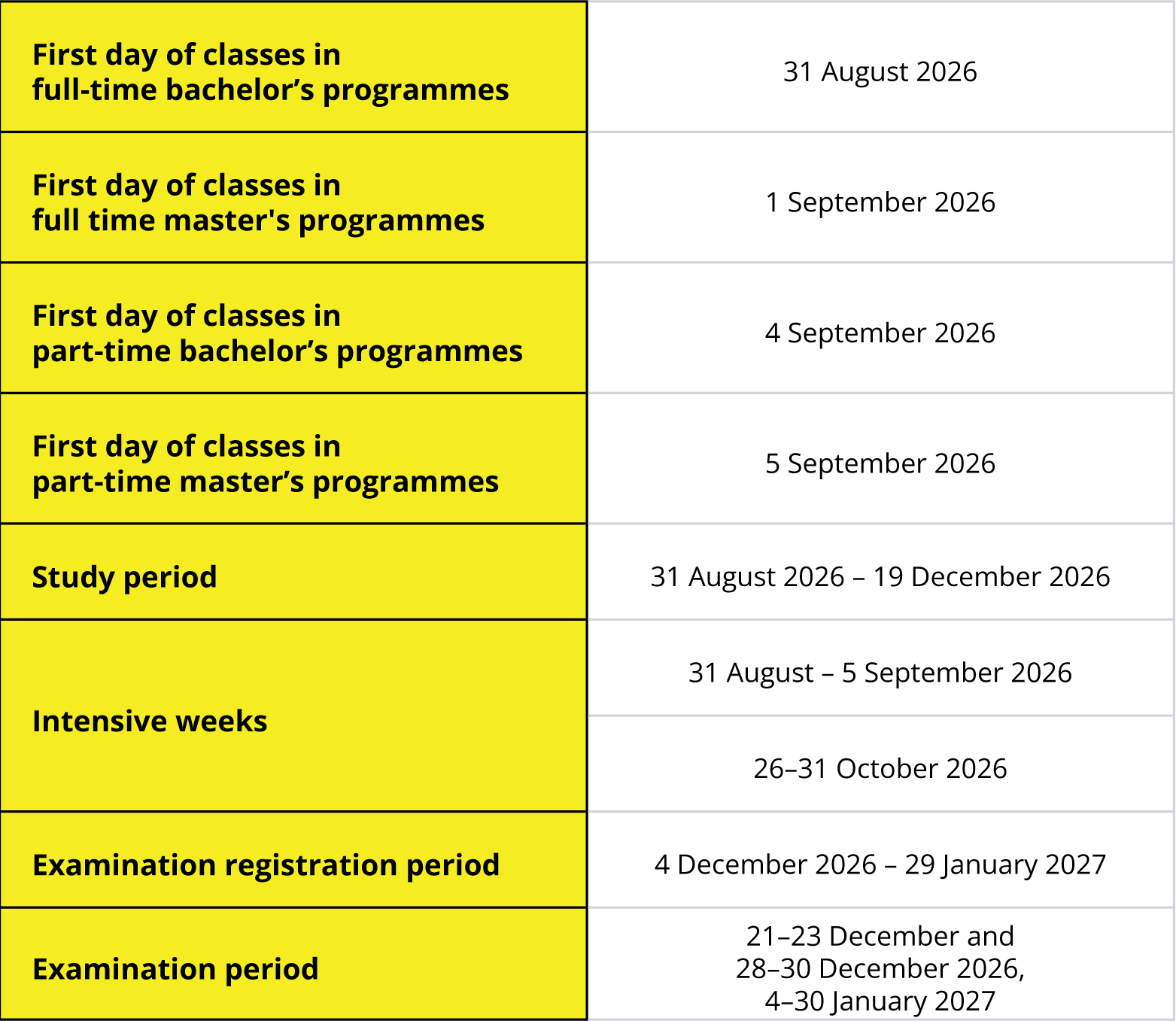
Autumn Semester schedule:
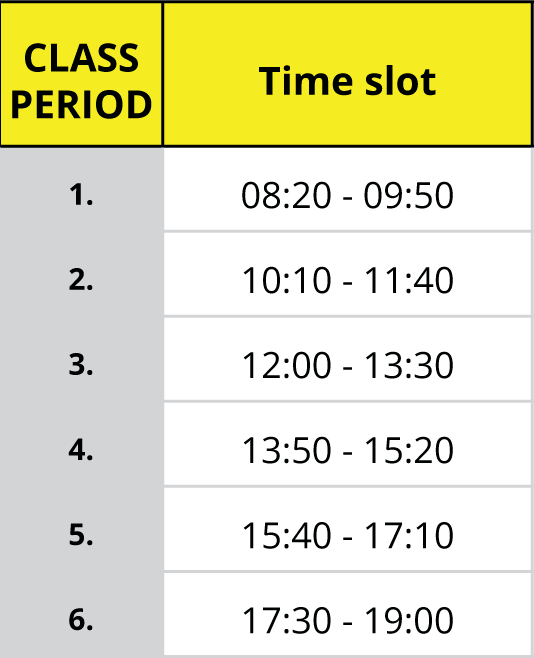
Timeslot schedule for full-time students:
You can see your class timetable in the Neptun system. In the full-time programme, assessments are scheduled at times separate from classes, while in the part-time programme they are scheduled to align with classes.
When planning your university tasks and other commitments, keep in mind that your assessments can fall anywhere within the designated test timeslot, so do not schedule any fixed plans during that period. If you are in the part-time programme, note that a more flexible choice of timing is available for term tests: each term test can be written on either of two consecutive weekends.
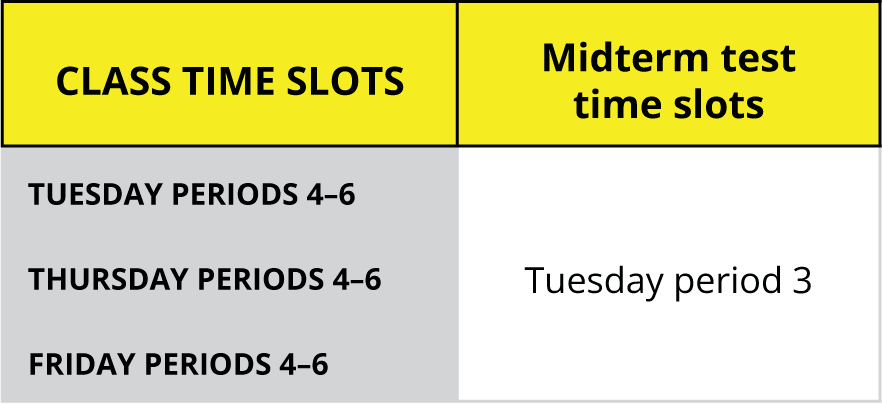
The days and time slots for classes and midterm tests at the different programme levels and study modes are as follows:
1) Full-time bachelor’s programmes
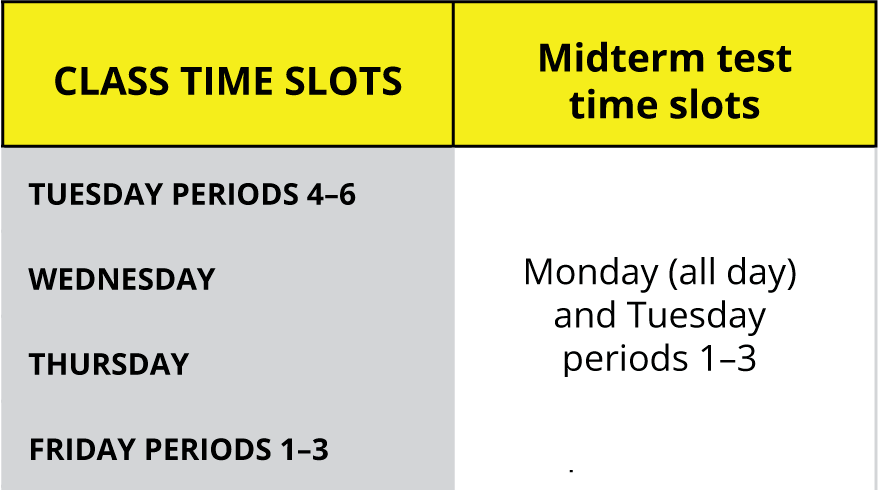
2) Full-time master’s programmes
3) Part-time bachelor’s programmes
Classes are held in person on Friday afternoons and on Saturdays. Term tests take place on Friday afternoons and on Saturdays.
4) Part-time master’s programmes
Classes are held in person on Saturdays; term tests take place on Friday afternoons and on Saturdays.
At the university, subjects are defined by their weekly number of classes (in the full-time programme) or by their semester-based number of classes (in the part-time programme). The weekly/semester number of classes indicates the number of (45-minute) classes held for the given subject.
- In the full-time programme, two of these always appear consecutively in the timetable, since classes are 90 minutes long. These may be lectures (in the academic system, in Neptun: theory), which primarily serve to convey the knowledge required for professional development. The other type of class is the practical class (seminars, labs), which typically involve smaller groups and are used to deepen and apply everything that instructors already consider known after the lectures. Lectures and practical classes together make up one subject; Neptun does not even allow them to be registered for separately.
- In the part-time programme, classes are grouped into blocks by subject (typically in blocks of 4 or 6 × 45 minutes) and appear in the timetable in this form. Here, every subject consists only of a lecture (in Neptun: theory) course, but this name does not imply any restriction on content — both types of class are present together within it.
Subjects (and their completion) are measured in credits by higher education. You earn credits by completing subjects, so a credit also expresses the total student workload required to complete the subject (i.e. it takes into account not only participation in contact hours but also the time required for tasks outside them, such as preparing for classes and assessments, or completing homework). Obtaining one credit corresponds to roughly 30 hours of student work.
Every subject therefore has its own credit value; your compulsory and compulsory elective subjects are worth 3 to 6 credits. If you meet the requirements of a given subject, i.e. you obtain at least a pass grade, you receive the credits for that subject. The credit value of individual programmes differs based on the number of semesters in the programme, but we recommend completing roughly 30 credits per semester (approx. 5–7 subjects).
We only recommend this, though, because the credit system is flexible. You do not need to complete exactly 30 credits every semester. Situations may arise where you can register for and complete fewer subjects than that, but you have the option of making up for it in a later semester by registering for and completing subjects worth more credits. Your model curriculum indicates which subjects are recommended to take when, i.e. in what sequence (meaning in which semester). You may deviate from this recommended schedule, but doing so may extend your length of study and make your university tasks harder to plan.
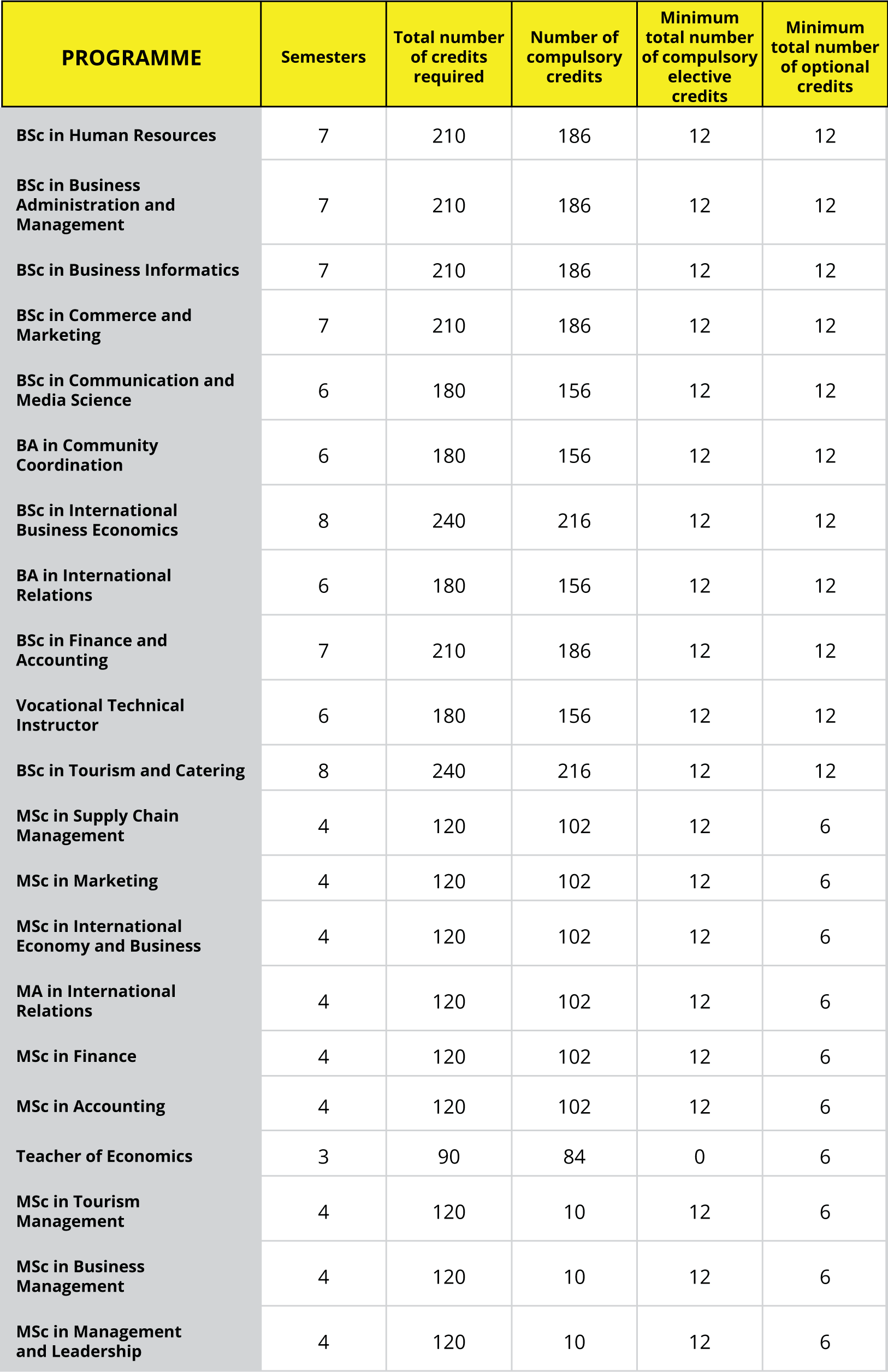
The model curriculum shows the subjects (and thus also the credits belonging to them) in the recommended order of completion, although you may deviate from this. At the university, failing to complete a given subject generally does not mean “repeating a year”, since you will simply need to make up that particular subject later — possibly alongside other subjects. That is, following the logic of the credit system, you can obtain the credits required for your degree (diploma) in a shorter or longer time than the standard length of the programme.
The credit system allows for flexible completion of the model curriculum; however, this has limitations and drawbacks that are worth being aware of:
- Not every subject is announced every semester. So it may happen that you have to wait a full year to register for a subject you have not yet completed.
- In some cases, registering for certain subjects must be preceded by completing other subjects — these are called pre-requisites. Model curricula also include these pre-requisites.
- We plan university life (for example, the scheduling of classes and test timeslots) according to progress through the model curriculum. If you deviate from the model curriculum, these timeslots may overlap and cause conflicts.
The model curricula for the individual programmes can be found HERE .
The model curriculum includes different types of courses:
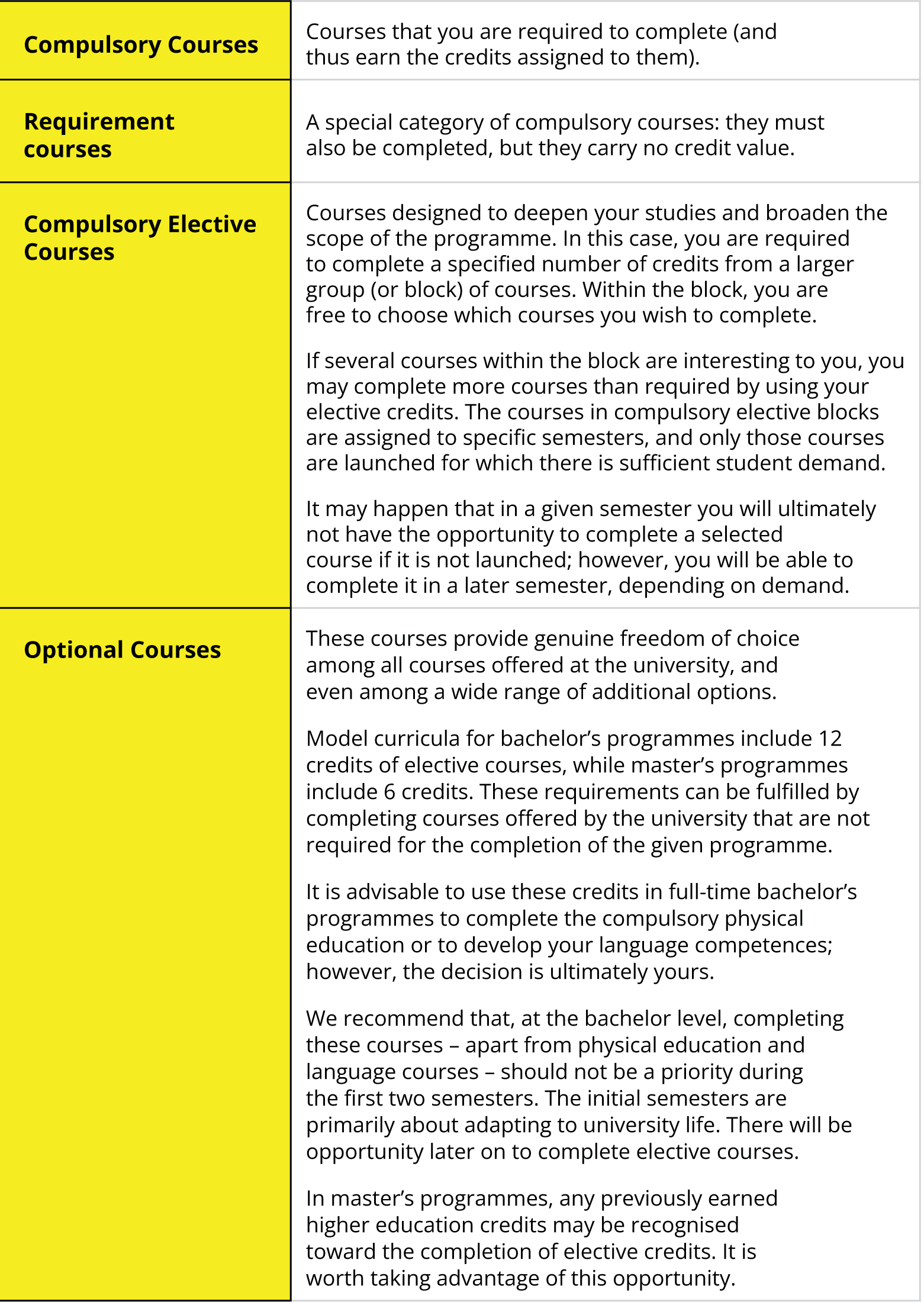
Subjects are announced and delivered in the form of courses. Besides the previously mentioned lecture (theory) and practical class types, courses also come in two course types that you may encounter:
- Normal course: typically a course type held with a set number of contact hours, which can be completed by meeting defined in-term requirements. In your first semester, you can only register for this type of course.
- Exam course: this course type has no contact hours, only an exam opportunity, meaning it can only be completed by passing an exam. An exam course can only be taken by a student who has already obtained the so-called End-of-term Signature (see below) for the subject in an earlier semester by meeting its in-term requirements. These are not relevant right now, but may become very important later on.
In terms of requirements, a subject can be exam-based (with a colloquium) or have a term grade (a practical grade). At BGE we use the names shown in brackets, and you will also see them in Neptun. It is important to know the requirement type of each subject, since this makes many completion requirements clear. The detailed completion requirements for subjects are contained in the subject descriptions, which you can access after registering for the subject in the education support system, CoSpace.
Most subjects at BGE can be completed both during the study term and during the exam period, since term grades are primarily obtained during the former, while for subjects ending in a colloquium (exam), an offered exam grade can already be earned during the study term. At the same time, most BGE subjects can also be completed by taking an exam during the exam period, provided certain minimum requirements are met. Accordingly, there are 2 important paths to completing a subject, involving 2 important steps:
1. The first step in completing a subject is meeting the study-term requirements (in other words: obtaining the End-of-term Signature). This is also important because without it you cannot obtain a grade at all, and it also entitles you to complete the subject during the exam period. In addition, once you have the End-of-term Signature, you can definitely re-register for the subject as an exam course the following semester; without the signature, however, you usually have to wait a full year to make it up (since not every subject is offered as a normal course every semester). Completing a subject via an exam course can reduce delays in your studies and drifting away from the model curriculum.
2. The second step in completing a subject is obtaining the grade. This can happen during the study term or during the exam period.
2a. For colloquium-based subjects, an offered exam grade can be earned based on the results of assessments held during the study term, and subjects with a term grade can also be completed at this time. The offered exam grade is worth exactly the same as an exam grade — the only difference is that it is earned not solely on the basis of a single exam, but on the basis of performance shown throughout the entire study term. This spreads the workload more evenly and can reduce tasks during the exam period. Moreover, accepting an offered grade is not compulsory, meaning you can also choose to take the exam during the exam period — presumably hoping for a better grade than the one offered.
2b. With the End-of-term Signature, subjects can be completed by taking an exam during the exam period — for both colloquium-based and term-grade subjects. The study term is followed by a 5-week exam period, which is a great opportunity for a more favourable distribution of subject completions over time.
It is therefore worth carefully planning your semester tasks. Continuously weigh up which subjects you have a chance of getting an offered grade in, and put more effort into those during the study term; and where this is no longer feasible, focus on obtaining the End-of-term Signature and on exam preparation during the exam period. Note: obtaining the End-of-term Signature is always the primary goal in every case — this is what you should focus on as a first step.
The requirements for completing a subject (e.g. for full-time bachelor programmes, mandatory attendance at some of the practical classes, the number of term tests, other in-term tasks) are contained in the subject description. Term tests (“zh”) and exams are an important element of assessing knowledge and its application. These assessments are conducted in a modern and secure technological environment, following standard processes and under identical conditions, by the Examination Centres (besides examination-centre assessments, there are also assessments held in classrooms (in a lecture hall, computer lab, or laboratory) — the subject description gives exact information about this). BGE operates an Examination Centre at three locations (the City Campus Examination Centre in the Alkotmány Street campus building, the Zugló Campus Examination Centre in the Buzogány Street campus building, and the Józsefváros Examination Centre in the Berzsenyi Street campus building).
The staff of the Examination Centre Office compile the schedule for the individual examination centres, organise the assessments and ensure they are conducted properly. If you have a question about the organisation of assessments, you can find the Examination Centre Office staff on the Student Request Portal (Hallgatói Igénybejelentő) interface, on the Examination Centre tile. For questions about the content of term tests or exams, contact the subject’s instructor.
For the sake of predictability, we publish the planned date of every assessment (term test and exam) in a uniform format on the website (“For Students” page / Schedule / Term Test and Exam Calendar)
You will need to register for term tests announced by the Examination Centre in the CoSpace system, but for every exam you will need to register in the Neptun system.
You can read more about the exam process HERE, and about the examination room rules HERE .
Below is a summary of the aspects you should pay particular attention to in order to ensure smooth progress in your studies:
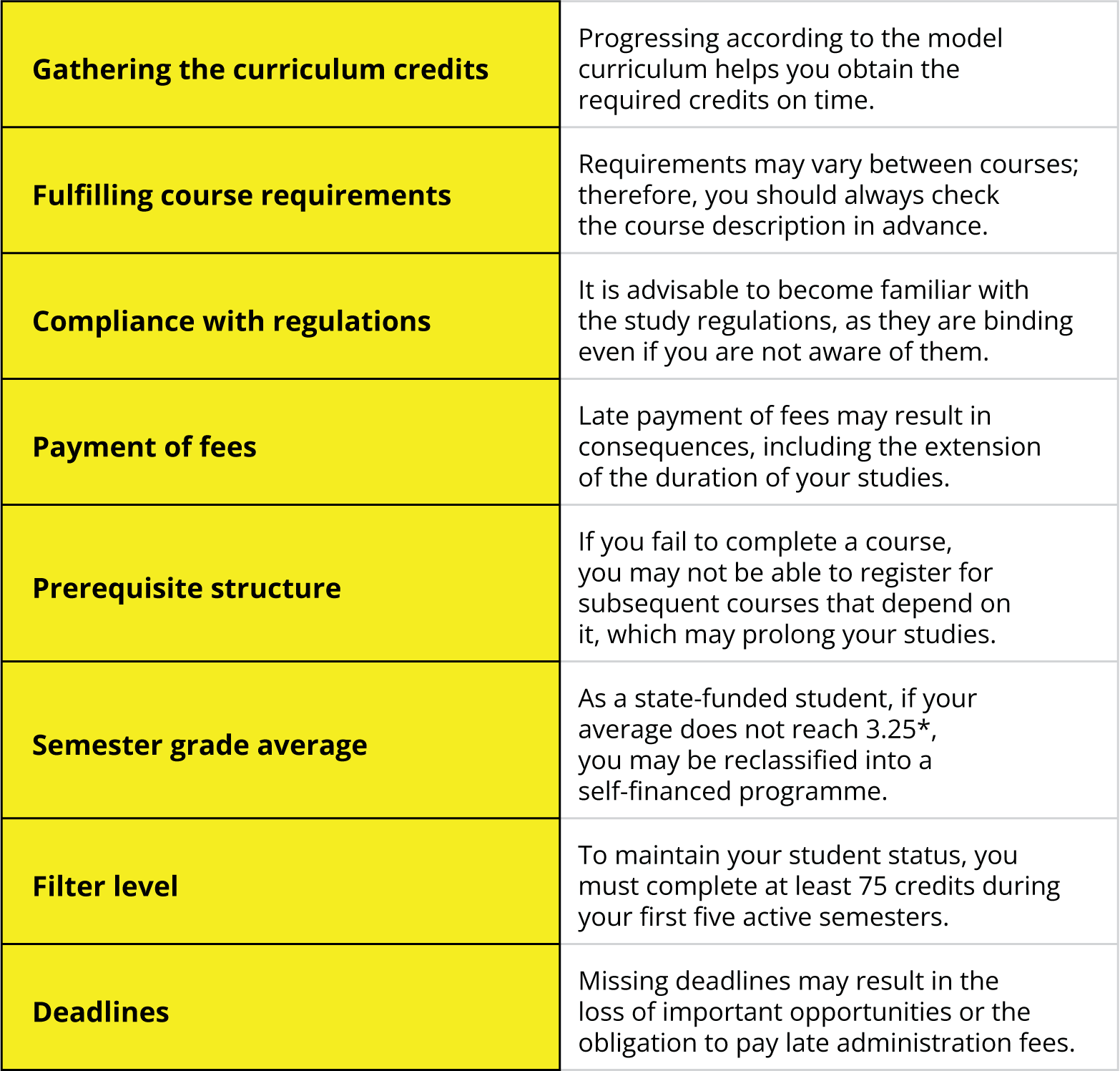
* The weighted grade average above applies to the fields of economics, social sciences, humanities, and teacher training. In the field of information technology, this average is 2.75.