BGE Main page
For students HU - Magyar

Budapest University of Economics and Business

  • Admission
      • Our programmes
      • Tuition fee
      • Bachelor's
      • Master's
      • Doctoral School
      • Erasmus+
      • Intensive week
      • Double degrees
      • Application
      • Admission process
      • Stipendium Hungaricum scholarship
      • Institutional transfer
      • Visa and residence permit
      • Accomodation & living expenses
      • Life in Budapest
      • Student life
      • Freshmen guide
      • Student Services Centre
      • BGE scholarships
      • BEE mentorship
      • Student organizations
      • Sport & health
  • Our university
      • About us
      • About BGE
      • Foundation for the Budapest University of Economics and Business
      • Management of BGE
      • Faculties of BGE
      • International relations
      • Internationalization at BGE
      • Accreditations
      • Partner Universities
      • International Projects
      • Inbound mobilities
      • Staff and faculty members
      • Student opportunities
      • Science
      • Science Life at BGE
      • BGE Publications
      • Talent development
      • BGE University Library
      • Repository
      • BUEB Community
      • Sustainability
      • Business Partnership
      • BGE Alumni
      • Contact
  • For students
  • For our colleagues
  • Apply here!
Home page >
Day of Hungarian Science 2026
Budapest University of Economics and Business
BGE
Search
Menu
Search
Menu
Day of Hungarian Science 2026
November 9, 2026
Day of Hungarian Science 2026

Each November, the Hungarian Academy of Sciences (MTA) organises the Celebration of Hungarian Science, one of the most prestigious events in Hungary’s academic and scientific calendar. In 2026, as the Academy and its Library commemorate the 200th anniversary of their foundation across 2025 and 2026, the event will once again be officially held under the title “Jubilee Celebration of Day of Hungarian Science” .

The motto of the 2026 Jubilee Celebration of Hungarian Science is “Freedom and Science.”

In-person participation only.

Sustainable and Liveable Cities in the 21st Century.
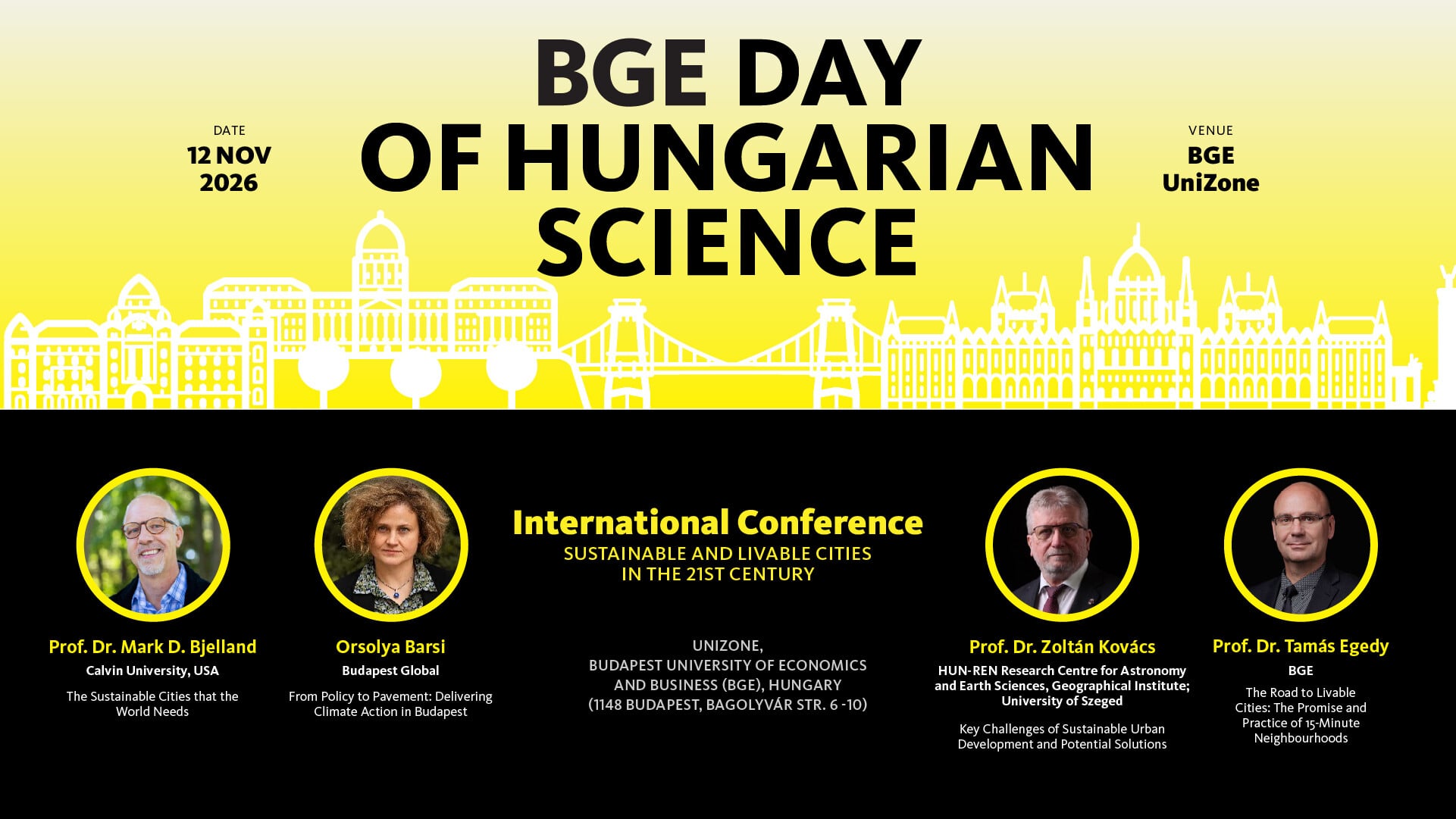
For more than twenty years each November the Hungarian Academy of Sciences (MTA) organises events for the Celebration of Hungarian Science. To this distinguished event, Budapest University of Economics and Business (BGE) is joining this year’s by organising a conference entitled: Sustainable and Liveable Cities in the 21st Century.

As part of the BGE Day of Hungarian Science, this international conference focuses on one of the most defining processes of human development: urbanization. Since the Second World War, urbanization has become a key driver of global transformation, with more than half of the world’s population now living in cities. As a result of advanced urbanization and accelerated urban development, cities have become the primary arenas of human consumption both globally and locally. Since the turn of the millennium, increasing social pressure has been placed on cities, while they have also been facing growing economic challenges. Accordingly, over the past two decades, the issues of sustainability and liveability of cities have come to the forefront both internationally and domestically. According to postmodern scientific theories, the future of economic development largely depends on the type of socio-economic environment that cities can provide for residents and businesses. In this context, sustainability and liveability play a crucial role in the success of future cities. In response, BGE organizes an international conference with distinguished international and dome stic speakers to review scientific findings, urban development directions, urban policy concepts, and economic experiences related to the sustainability and liveability of cities. Through this initiative, the University aims to contribute to addressing the most important social and economic challenges of urban development.

Date: 12 November 2026

Venue: BGE UniZone, 1148 Budapest, Bagolyvár street 6–10. 

Participation in the conference is free, but registration is required.

Organizing Committee:
Prof. Dr. György Andor (Chair); Dr. habil. Krisztina Szegedi (Vice-Chair), Prof. Dr. Zsuzsanna Győri, Zarándné Dr. Kornélia Vámosi, Dr. habil. Tímea Kozma, Dr. Szilárd Hegedűs

We invite individual and collaborative proposals for the following 9 conference sessions, which engage with broad questions and further explore the themes outlined below:

  • Economic Challenges of Sustainable and Liveable Cities
  • Social Issues, Civil Society and Communities in Sustainable and Liveable Cities
  • Towards Sustainable and Liveable Cities: Strategies, Urban Policies and International Perspectives
  • Financial, Accounting and Controlling Challenges in the 21st Century
  • Digital Transformation in Management
  • Sustainability, Marketing and Communication: Solutions for the 21st Century
  • Smart Cities, Smart SMEs: Digital Finance and AI-Enabled ESG Education Solutions from the FinArch and Dedycating Projects
  • Circular Communities in Fashion
  • Leveraging AI to Enhance Business Competitiveness (Prosperitas Special Issue)

The conference offers four publication opportunities. For more information, please scroll down to the “Where to Publish” section on this page.

Deadline for abstract submission: 26 October 2026, 23:59 (CET)
Deadline for full manuscript submission: 30 November 2026, 23:59 (CET)

The submission platform is available at this page.



Plenary program and speakers

08:30

Registration 

09:00

Dr. habil. Krisztina Szegedi

Vice-Rector for Research

BGE

Opening ceremony and Award Presentation

09:10

Prof. Dr. Mark D. Bjelland

Chair, Department of Geology, Geography, and Environment

Calvin University

The Sustainable Cities that the World Needs

09:35

Orsolya Barsi

Head of Department

Department for Climate- and Environmental Affairs

Budapest Global 

From Policy to Pavement: Delivering Climate Action in Budapest


10:00

Coffee break

10:20

Prof. Dr. Zoltán Kovács

HUN-REN Research Centre for Astronomy and Earth Sciences, Geographical Institute;

University of Szeged

Key Challenges of Sustainable Urban Development and Potential Solutions


10:45

Prof. Dr. Tamás Egedy

Department of Sustainability

BGE

The Road to Livable Cities: The Promise and Practice of 15-Minute Neighbourhoods


11:10

Round-table discussion
Moderator: Dr. Tamás Németh

Department of Management and Organization

BGE

12:00

Lunch break

12:45

Afternoon sessions

The session schedule and the venues for each session will be announced after the abstract submission deadline.

Abstracts of the Plenary Presentations

Prof. Dr. Mark D. Bjelland - The Sustainable Cities the World Needs

Cities and towns are where our planet’s future lies. The United Nations reports that while cities cover just 3% of global land area, they consume about three-quarters of all energy and emit about three-quarters of global carbon emissions. Addressing key global challenges of climate change, energy transition, environmental quality, disaster resilience, and poverty requires that architects, city planners, engineers, real estate developers, transportation planners, and urban designers work together towards more sustainable forms of urbanization. Different concepts for sustainable cities abound: the New Urbanism, the compact city, the transit city, the bicycle city, the biophilic city, the walkable city, and the 15-minute city. Drawing upon several decades of research on sustainable cities, this talk presents best practices for sustainable urbanism from Minneapolis, Portland, Vancouver, London, and other cities. There are important lessons to be learned from different parts of the world but true sustainability involves striking a balance between environment, equity, and economy that fits the local context. Further, while it is tempting to start fresh in the quest to build more sustainable cities, true sustainability begins with reusing, recycling, and retrofitting the cities we’ve inherited from the past.  

Orsolya Barsi - From Policy to Pavement: Delivering Climate Action in Budapest

Orsolya Barsi’s presentation sets out how Budapest is working towards climate neutrality while adapting to a fast-changing climate. Downscaled projections point to fewer but more intense rainfall events, longer dry spells and rising heat: days above 35 °C are expected to roughly double by 2050–2070, and tropical nights have already risen from 6 to 17 a year on average. The city is responding with a rainwater strategy, heat-relief measures, Healthy Streets and street renewals, and green infrastructure ranging from rain gardens and courtyard greening to wildflower meadows. On mitigation, an emissions inventory dominated by buildings (61%) and transport (29%) guides action on energy efficiency through the Budapest Climate Agency, positive energy districts, solar mapping, e-mobility, city logistics and sustainable food systems. Budapest holds both EU Mission labels; it is implementing its Climate City Contract and, through the SPARC project within Pathways2Resilience, co-designing a Climate Resilience Strategy, Action Plan and Investment Plan.

Prof. Dr. Zoltán Kovács - Key Challenges of Sustainable Urban Development and Potential Solutions

Contemporary urbanisation processes pose numerous challenges to sustainable urban development. The uneven spatial distribution of population and capital, increasing mobility, inefficient land use, the lack of adequate green spaces, and the adverse effects of climate change often disrupt the spatial balance of urban carrying capacity, seriously threatening the liveability of our cities. Drawing on research conducted in Budapest and other major Hungarian cities over the past two decades, this presentation examines the key challenges of sustainable urban development and the potential responses to them. Our primary aim is to systematically identify and assess the processes that negatively affect sustainable urban development, as well as the underlying socio-economic factors. The presentation will also review and evaluate a range of potential solutions, drawing in part on international good practices.

Prof. Dr. Tamás Egedy - The Road to Livable Cities: The Promise and Practice of 15-Minute Neighbourhoods

The 15-minute city concept has emerged as a prominent urban planning theory that seeks to create more accessible, sustainable, and socially connected cities. By enabling residents to reach essential services, employment, education, recreation, and public spaces within a short walk or cycle, the model challenges car-dependent patterns of urban development. The presentation examines both the promise and practical implementation of 15-minute neighbourhoods based on the empirical results of the 15minEstates Horizon Europe Partnership project carried out in Budapest-Pesterzsébet. The presentation highlights the challenges, opportunities and outcomes of the ‘15-minute city’ concept in a housing estate setting, as well as how the local community can be involved in the planning and implementation of developments affecting mobility and the environment within the neighbourhood. The findings of this international project could help ensure that the ‘15-minute city’ concept successfully contributes to making cities more liveable.


BGE Day of Hungarian Science Registration 2026

Folder, document name
Last modification

BGE Day of Hungarian Science- Call for papers 2026.pdf

Updated:
2026. October 01.

Section brochure_BGE Day of Hungarian Science 2026.pdf

Updated:
2026. November 09.

Where to publish?

The conference offers four publication opportunities:

  • Conference proceedings: publishing in a peer-reviewed conference proceeding with an ISBN number containing studies with a separate DOI number (manuscripts requirements are available on the website)
  • Prosperitas (Scopus-indexed journal): selected papers that meet the requirements of Prosperitas can be submitted for peer review. For more information about submission to Prosperitas, click here.
  • BGE's academic journals: Publication opportunities are offered in the university’s academic journals: Business & Diplomacy Review and Multidisciplinary Challenges, Diverse Responses

During manuscript submission, authors are required to specify the intended publication venue. This information is particularly important, as it will be taken into account during the editorial and review process.

  • For manuscripts intended for the conference proceedings and for Prosperitas, papers must comply with the content and formatting requirements of Prosperitas.
  • For manuscripts intended for Business & Diplomacy Review and Multidisciplinary Challenges, Diverse Responses, authors are advised to visit the official websites of the respective journals and ensure that their submissions meet the relevant content, formatting, and submission criteria.

In the first stage, all manuscripts must be uploaded via the Manuscript Submission page indicated on the conference website. Authors will be notified about the next steps after submission.

Manuscript submission

In the case of co-authored papers, one author should submit the manuscript on behalf of all co-authors. Before submission, please ensure that the names and affiliations of all authors are clearly indicated in the manuscript.
Publication Opportunities
Please upload your document in Word format (.docx).

Have questions about the conference? Feel free to reach out to!

NameE-mail

Dr. Dorina Körtvési

kortvesi.dorina@uni-bge.hu

2026 - Budapest University of Economics and Business - All rights reserved v1.14.3
Useful links
  • Data of public interest
  • Regulatory Documents
  • IT guides
  • Campus locations
  • Conditions of Use
  • Cookie settings
  • Privacy Policy
  • Requirement System for Students
  • Developments
Follow us
made by